
Business signage regulations shape the look of every high street in London, guiding how shops and offices display their signs in public spaces. Plenty expect these rules to centre purely on size or colour. Yet compliance has far bigger consequences than most realise. Breaking signage rules can land a business with fines up to £5000 and force immediate sign removals. That little shopfront sign becomes a major decision for your reputation and your wallet.
Table of Contents
Table of Contents
- What Are Business Signage Regulations?
- The Importance of Compliance With Signage Laws
- Key Concepts of Signage Regulations in London
- Practical Applications of Business Signage Regulations
- Real-World Context: Impact on Business Operations
Quick Summary
| Takeaway | Explanation |
|---|---|
| Understand signage regulations | Familiarize yourself with local rules to avoid fines. |
| Obtain necessary permissions | Consult local authorities before installing business signs. |
| Design compliant signage | Follow regulations to maintain a professional image and avoid penalties. |
| Maintain documentation | Keep detailed records of your signage proposals for compliance validation. |
| Consider strategic placement | Assess sign placement to enhance visibility while adhering to regulations. |
What Are Business Signage Regulations?
Business signage regulations represent a comprehensive set of legal guidelines that control how businesses display exterior and interior signs in urban environments like London. These regulations aim to balance commercial communication needs with aesthetic, safety, and public space management considerations.
The Purpose of Signage Regulations
Signage regulations serve multiple crucial functions for urban landscapes. They ensure that business signs do not create visual clutter, compromise public safety, or detract from the architectural character of different neighbourhoods. Local authorities establish these rules to maintain a cohesive and professional urban aesthetic while providing businesses reasonable opportunities to communicate their brand and services.
Key objectives of business signage regulations include:
- Protecting historical architectural integrity
- Ensuring public safety and visibility
- Maintaining consistent streetscape design
- Preventing excessive commercial visual pollution
Regulatory Framework in London
In London, signage regulations are typically governed by local borough councils and fall under planning permission guidelines. Businesses must navigate complex requirements that vary depending on several factors such as:
- Location of the premises (conservation area, high street, industrial zone)
- Size and type of signage
- Building’s historical or architectural significance
- Proximity to residential areas
According to Westminster City Council, businesses must obtain specific permissions before installing external signs, with different rules applying to listed buildings, conservation areas, and standard commercial properties.
Understanding these regulations is crucial for businesses to avoid potential legal complications, fines, or mandatory sign removals.
Learn more about designing compliant building signage to ensure your business meets all local requirements.
The Importance of Compliance with Signage Laws
Compliance with signage laws represents more than just legal obligation. It is a strategic approach that protects businesses from potential financial penalties, legal challenges, and reputational damage while ensuring public safety and maintaining urban aesthetic standards.
Financial and Legal Consequences of Non Compliance
Failing to adhere to signage regulations can result in significant financial and legal repercussions for businesses. Local authorities in London have robust enforcement mechanisms designed to ensure strict adherence to established guidelines. Potential consequences include:
- Immediate removal of non compliant signage
- Substantial financial penalties ranging from £500 to £5000
- Mandatory retrospective planning applications
- Potential legal proceedings and court appearances
Businesses that ignore these regulations risk not just financial penalties but also potential interruption of their commercial operations. Proactive compliance is always more cost effective than reactive correction.
Reputation and Professional Image
Beyond legal ramifications, signage compliance directly impacts a business’s professional reputation. Non compliant signage can signal organisational negligence to potential customers and partners. Professional businesses demonstrate their commitment to local regulations and community standards through carefully designed and legally approved signage.
According to London Local Government Association, businesses that consistently meet regulatory requirements are perceived as more trustworthy and community oriented.
Learn about comprehensive signage compliance strategies to protect your business and maintain a professional image in London’s competitive commercial landscape.
Key Concepts of Signage Regulations in London
Signage regulations in London represent a complex framework of legal guidelines designed to balance commercial communication with urban aesthetic preservation. Understanding these key concepts is crucial for businesses seeking to navigate the intricate landscape of signage permissions.
Classification of Signage Types
London’s regulatory approach categorises business signs into distinct classifications, each with specific rules and permissions. These classifications determine the level of regulatory scrutiny and potential approval processes. Primary signage categories include:
- Fascia signs (primary business identification)
- Projecting signs
- Illuminated signs
- Temporary signs and advertisements
- Branded window displays
Each category requires different levels of planning permission and must adhere to specific size, placement, and design guidelines set by local borough councils.
The following table clearly categorises the different types of business signage recognised by regulatory authorities in London, along with their typical features and planning requirements.
| Signage Type | Description | Typical Planning Requirements |
|---|---|---|
| Fascia Signs | Main identification signs fixed to the shopfront | Often require planning permission, especially in conservation areas |
| Projecting Signs | Signs that extend perpendicular to the building | Require permission; stricter in historic zones |
| Illuminated Signs | Signs featuring internal or external lighting | Planning permission and additional electrical safety compliance |
| Temporary Signs | Short-term adverts or notices | Generally allowed for limited durations; must adhere to local rules |
| Branded Window Displays | Business branding affixed to windows | May require permission if large or illuminated |
Regulatory Considerations for Sign Placement
Sign placement involves multiple critical considerations beyond simple visual appeal. Businesses must navigate complex regulatory requirements that account for:
- Proximity to historical buildings
- Impact on street scene aesthetics
- Safety considerations for pedestrians and road users
- Conservation area restrictions
- Building structural integrity
According to the Town and Country Planning Act, local planning authorities have significant discretion in determining sign appropriateness and potential impact on urban environments.
Explore our comprehensive guide to retail signage compliance to ensure your business meets all necessary regulatory standards in London’s dynamic commercial landscape.
Practical Applications of Business Signage Regulations
Practical application of business signage regulations transforms legal guidelines into actionable strategies for businesses operating in London. Understanding how to implement these regulations effectively requires a nuanced approach that balances legal compliance with business communication objectives.
Preparing Signage Documentation
Successful regulatory compliance begins with comprehensive documentation and proactive planning. Businesses must develop a detailed signage strategy that anticipates potential regulatory challenges. This preparation involves:
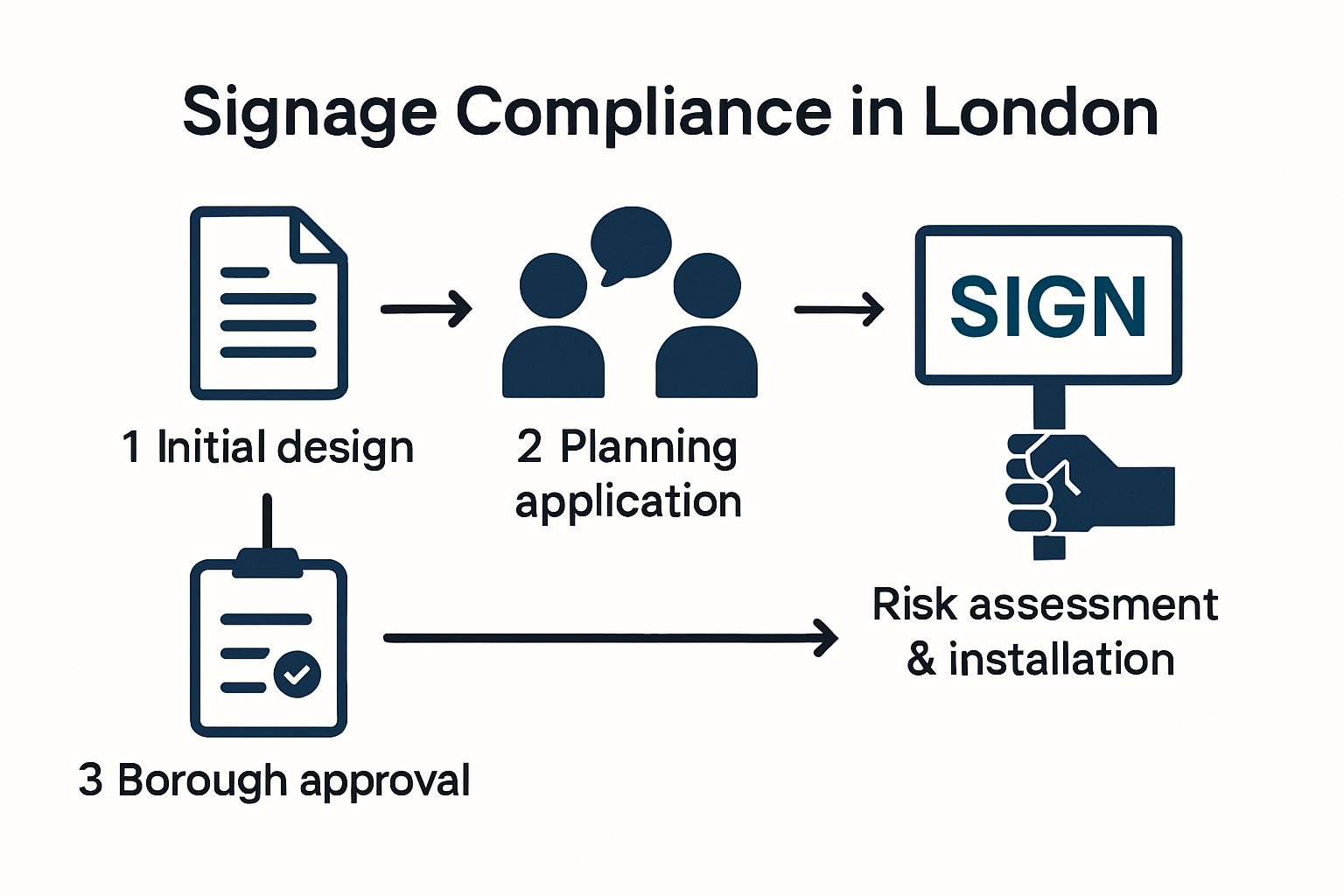
- Creating precise architectural drawings of proposed signage
- Documenting material specifications and dimensions
- Obtaining preliminary assessments from local planning authorities
- Maintaining comprehensive records of sign design iterations
- Preparing detailed site plans showing sign placement
Risk Mitigation and Approval Processes
Navigating the approval process requires strategic engagement with local regulatory bodies. Businesses must understand that each borough in London may have slightly different interpretation and implementation of signage regulations. Key strategies include:
- Conducting pre application consultations
- Understanding specific conservation area restrictions
- Developing design proposals that align with local aesthetic guidelines
- Engaging professional planning consultants when necessary
- Maintaining flexibility in design approaches
According to the UK Government’s Planning Portal, businesses must carefully consider multiple factors when developing signage proposals, including visual impact, historical context, and community standards.
Discover expert insights on creating compliant shop signs that meet both regulatory requirements and business communication objectives in London’s competitive commercial landscape.
Real-World Context: Impact on Business Operations
Business signage regulations are not merely theoretical guidelines but practical frameworks that directly influence commercial strategies and operational capabilities. These regulations create a complex ecosystem where legal compliance intersects with business communication and urban aesthetic management.
Financial and Strategic Implications
The impact of signage regulations extends far beyond simple visual compliance. Businesses must view signage regulations as strategic investments that require careful financial and operational planning. Regulatory adherence involves significant considerations:
- Initial design and consultation costs
- Potential redesign expenses
- Time investment in obtaining necessary permissions
- Potential operational delays during approval processes
- Risk management and legal compliance budgeting
Operational Challenges and Adaptation Strategies
Navigating signage regulations requires businesses to develop sophisticated adaptation strategies. Successful businesses treat regulatory compliance as a dynamic process of continuous learning and adjustment. Key operational challenges include:
- Managing extended approval timelines
- Understanding borough specific nuances
- Balancing brand identity with regulatory constraints
- Developing flexible design approaches
- Maintaining competitive visibility within legal frameworks
According to The London Plan, businesses must integrate signage strategies that align with broader urban design objectives while maintaining commercial effectiveness.
Explore strategic approaches to navigating signage regulations to transform compliance from a potential obstacle into a competitive advantage in London’s dynamic business landscape.
Stay Compliant and Make Your Business Stand Out in London
Struggling to understand the complex signage regulations in London can cause unnecessary delays, added costs, and even legal trouble for your business. With strict rules about sign placement, historic areas, and visual impact, it can be overwhelming to ensure your business signage meets every local requirement. If you want to keep your company protected while attracting more customers, you need a solution that does more than just tick boxes.

At PromoSigns, we specialise in designing, producing, and installing business signs that fully comply with London signage laws. From custom shop signs to professional illuminated signage, we have helped hundreds of businesses confidently navigate approval processes and protect their reputation. Let us handle the technicalities so you can focus on growing your brand without fear of costly mistakes or forced removals. Act now to secure a compliant and eye-catching sign that works for your business. Ready to take the next step? Visit PromoSigns and book your expert consultation today.
Frequently Asked Questions
What are the main objectives of business signage regulations in London?
Signage regulations in London aim to balance commercial communication needs with public safety, aesthetic integrity, and community standards. They help prevent visual clutter, protect historical architecture, and maintain cohesive streetscapes.
What are the potential consequences of non-compliance with signage regulations?
Non-compliance can lead to significant repercussions, including fines ranging from £500 to £5000, the mandatory removal of non-compliant signage, and potential legal proceedings. This can disrupt business operations and harm professional reputations.
How do I determine the type of signage that requires planning permission in London?
In London, the type of signage that requires planning permission varies based on factors such as the location of the premises, the size and type of signage, and whether the building is in a conservation area or has historical significance. It’s important to consult local borough councils for specific guidelines.
What steps should I take to ensure my signage complies with local regulations?
To ensure compliance, businesses should prepare comprehensive documentation, including architectural drawings, material specifications, and site plans. Engaging in pre-application consultations with local planning authorities also helps to navigate the approval process effectively.
Recommended
- Signage Size Guidelines 2025: The Essential Guide for London Businesses – PromoSigns.co.uk
- Retail Signage Compliance Guide 2025 for London Businesses – PromoSigns.co.uk
- How to Design Building Signage: A 2025 Guide for London Businesses – PromoSigns.co.uk
- Shop Signage Basics 2025: Essential Tips for London Businesses – PromoSigns.co.uk
- Waste Disposal Legal Requirements UK 2025: What Businesses Must Know – Venture Waste
