
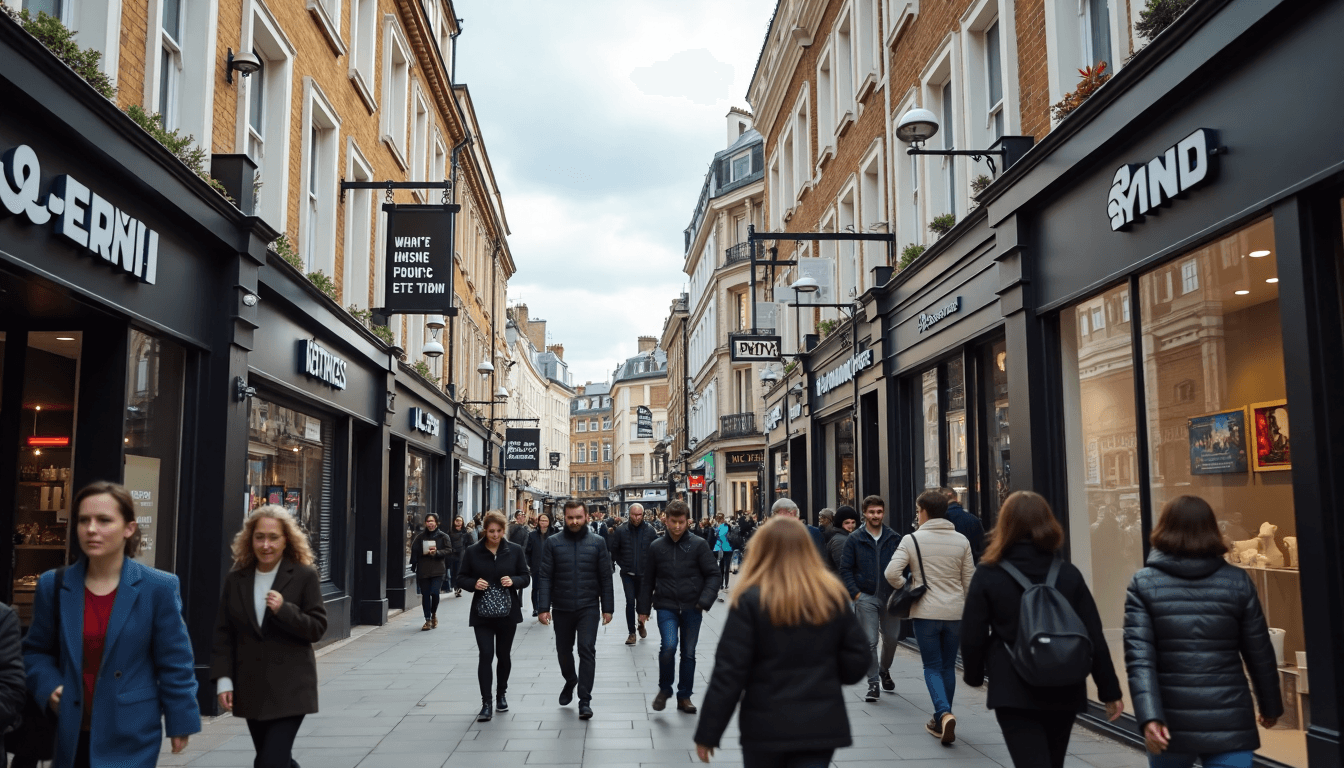
Signage can either draw a crowd or leave your business overlooked on London’s busy streets. Here is what might surprise you: signs larger than 0.3 square metres often require special advertisement consent from local councils. So while bigger might seem better, the smartest businesses succeed by using strategic sizes and clever placement that keep them visible and on the right side of the law.
Table of Contents
Table of Contents
- Choosing The Right Signage Size For Your Business
- Standard Signage Sizes For Shops, Offices, And Events
- Legal Requirements And Best Practices For London Signage
- Custom Signage Solutions For Different Industries
Quick Summary
| Takeaway | Explanation |
|---|---|
| Sign Size Matters | For every 10 feet of viewing distance, signage should have approximately 1 inch of letter height to ensure readability. This varies by business environment and local regulations. |
| Regulatory Compliance Is Essential | Businesses must adhere to local safety standards and obtain advertisement consent for signs larger than 0.3 square metres, especially in conservation areas or historic buildings. |
| Tailored Approaches for Different Contexts | Signage size and design should be customised based on the type of business (retail, office, events) and the location to effectively engage the target audience. |
| Consistent Colour and Contrast | Sign designs should follow established colour codes that enhance readability and ensure clear communication, particularly for safety information. |
| Prioritise Accessibility | Signs must accommodate all individuals, including those with visual impairments, and should be strategically placed for maximum visibility. |
Choosing the Right Signage Size for Your Business
Selecting the appropriate signage size for your business requires careful consideration of multiple factors that directly impact visibility, readability, and overall marketing effectiveness. The right sign can transform your business’s street presence, while an incorrectly sized sign might render your message invisible or unprofessional.
Understanding Visibility and Distance Perception
Signage effectiveness depends critically on understanding how viewers perceive information from different distances. The International Sign Association recommends calculating sign size based on objective factors including viewing distance, speed of potential viewers, and environmental context. For instance, a sign viewed by pedestrians requires different sizing compared to one targeting motorists.
The general rule of thumb for signage sizing involves a straightforward calculation: for every 10 feet of viewing distance, you need approximately 1 inch of letter height. This means a sign meant to be read from 100 feet away should have letters around 10 inches tall. However, this is not a universal standard and varies depending on specific business environments and local regulations.

Regulatory Considerations and Safety Standards
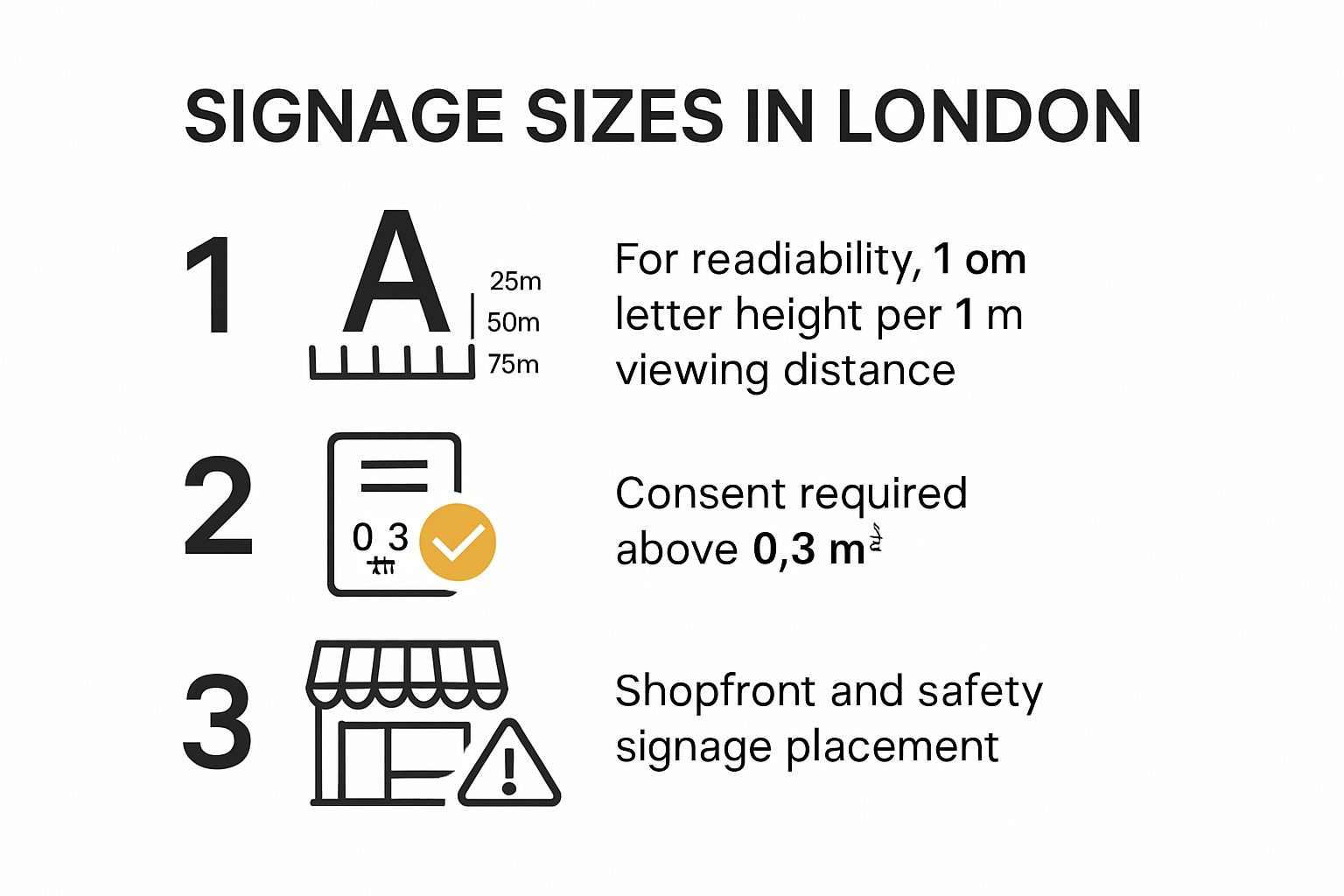
Business owners must also navigate legal requirements when designing signage. The Health and Safety Regulations specify that safety signs must be uniform and easily comprehensible. These guidelines ensure that signs are not just visually appealing but also functionally effective and compliant with municipal codes.
Consider factors such as:
- Mounting Height: Signs must be placed at appropriate heights to ensure visibility and safety.
- Projection Limits: Some jurisdictions have specific rules about how far signs can extend from buildings.
- Readability Zones: Different urban areas might have unique requirements for sign dimensions and placement.
Strategic Sizing for Maximum Impact
Beyond technical calculations, strategic sign sizing involves understanding your specific business context. A small boutique might require a more intimate, detailed sign, while a large restaurant could benefit from a bold, expansive display. Learn more about crafting the perfect commercial sign to understand nuanced design strategies.
Key considerations include:
- Business Type: Retail, professional services, and hospitality have different signage needs.
- Location Context: Urban high streets versus suburban areas demand different visual approaches.
- Brand Identity: Your sign should reflect your brand’s personality and professional image.
Remember that signage is more than just information transmission—it’s a critical marketing tool that communicates your brand’s professionalism, style, and attention to detail. Investing time in understanding and implementing appropriate signage sizing can significantly enhance your business’s visual communication and street-level appeal.
Standard Signage Sizes for Shops, Offices, and Events
Navigating the world of signage sizes requires a nuanced understanding of different business environments and their unique visual communication needs. From compact retail spaces to expansive corporate offices and dynamic event venues, each setting demands a tailored approach to signage dimensioning.
Retail and Shop Signage Dimensions
In the retail sector, signage plays a crucial role in attracting customer attention and communicating brand identity. According to Manchester City Council’s Shopfront and Signage Design Guide, fascia signs typically range between 40% to 70% of the shopfront width. For small shops (under 3 meters wide), the recommended fascia height is approximately 40-50 centimetres, while larger establishments can accommodate signs up to 60-80 centimetres tall.
Key considerations for retail signage include:
- Storefront Proportions: Sign size must harmonise with the architectural features of the building.
- Readability Distance: Signs should be legible from both pedestrian and vehicular perspectives.
- Regulatory Compliance: Government guidelines mandate that signs larger than 0.3 square metres typically require advertisement consent.
Below is a table summarising standard signage sizes and dimensions for shops, offices, and events for easy reference.
| Signage Type | Typical Dimensions (cm or metres) | Typical Use/Location |
|---|---|---|
| Shop Fascia – Small Shop | Height: 40–50 cm; Width: 40–70% shopfront | Small retail faces (<3m wide) |
| Shop Fascia – Large Shop | Height: 60–80 cm; Width: 40–70% shopfront | Large/high street units |
| Office Entrance Sign | Width: 60–90 cm; Letter: 7.5–15 cm | Main office building entrances |
| Reception Area Sign | Width: 30–45 cm | Office reception areas |
| Corridor Wayfinding | Width: 20–30 cm | Hallways, corridors |
| Event Banner – Small | 1 x 2 m | Small events, pop-ups |
| Roll-up Banner | 0.85 x 2 m | Exhibitions, indoor events |
| Conference Backdrop – Large | 3 x 4 m | Major events, stage backdrops |
Office and Professional Space Signage Standards
Professional environments demand a more subdued yet professional approach to signage. Typical office sign dimensions vary based on the building’s scale and the specific area of application. Entrance signs often range from 60 to 90 centimetres in width, with letter heights between 7.5 to 15 centimetres depending on viewing distance and architectural context.
Interior directional signs follow different sizing principles:
- Reception area signs: 30-45 centimetres wide
- Corridor wayfinding signs: 20-30 centimetres wide
- Room identification signs: 15-25 centimetres wide
Event and Temporary Signage Specifications
Event signage requires maximum flexibility and impact. Check out our comprehensive guide to event signage for more detailed insights. Banner sizes typically range from:
- Small event banners: 1 x 2 metres
- Medium exhibition signs: 2 x 3 metres
- Large conference backdrops: 3 x 4 metres
Portable display signs for conferences and trade shows often follow these standard dimensions:
- Popup display stands: 2.2 x 1.2 metres
- Roll-up banners: 0.85 x 2 metres
- Tabletop displays: 1 x 0.5 metres
Professional signage is more than just dimensions. It is a strategic communication tool that reflects your brand’s professionalism, attention to detail, and visual identity. Whether you are a small boutique, a corporate office, or an event organiser, understanding these sizing guidelines will help you create impactful visual communications that resonate with your target audience.
Legal Requirements and Best Practices for London Signage
Navigating the complex landscape of signage regulations requires a comprehensive understanding of legal frameworks and municipal guidelines specific to London businesses. Compliance is not just about avoiding penalties but ensuring your signage effectively communicates your brand while meeting safety and aesthetic standards.
Regulatory Compliance and Safety Standards
The Health and Safety Regulations establish critical guidelines for signage design and implementation. These regulations mandate that safety signs must be uniform, easily comprehensible, and designed to provide clear communication across diverse audiences. For businesses, this means developing signage that is not only visually appealing but also universally understandable.
Key regulatory considerations include:
- Visibility Requirements: Signs must be clearly visible and positioned to maximise comprehension.
- Material Specifications: Use materials that maintain legibility and durability in various environmental conditions.
- Colour and Contrast: Adhere to standard colour codes that enhance readability and signal specific information.
Below is a table outlining key compliance and permission requirements for signage within London, organised by consideration area.
| Compliance Area | Requirement | Notes |
|---|---|---|
| Size Limit | Max. 0.3 sq. m without consent | Larger signs require advertisement consent |
| Illumination | Consent needed for illuminated external signs | Internal/external lighting rules vary |
| Conservation Area | Often stricter rules or additional consent | Applies to listed buildings & historic districts |
| Colour & Contrast | Must follow standard codes | Enhances readability & safety, esp. for warnings |
| Accessibility | Must be accessible to visually impaired | Required for public/commercial premises |
| Placement | Must maximise visibility, respect architecture | Includes mounting heights and projection limits |
Planning Permission and Advertisement Consent
Government guidelines specify that businesses must obtain advertisement consent for signs larger than 0.3 square metres or any illuminated signage displayed externally. This requirement varies depending on the specific location, building classification, and local conservation area restrictions.
Consider the following when seeking permissions:
- Conservation Areas: Additional restrictions may apply in historically significant zones.
- Listed Buildings: Special permissions are required for signage on or near heritage properties.
- Illumination Regulations: Different rules govern internally and externally illuminated signs.
Professional Signage Design Best Practices
Explore our comprehensive guide to retail sign design for deeper insights into creating compliant and effective signage. Beyond legal requirements, successful signage integrates design principles that enhance brand communication and customer engagement.
Best practices include:
- Consistent Branding: Ensure signage reflects your brand’s visual identity.
- Accessibility Considerations: Design signs that are readable for all individuals, including those with visual impairments.
- Strategic Placement: Position signs to maximise visibility while respecting architectural and urban design contexts.
Compliance with legal requirements is more than a bureaucratic exercise—it is an opportunity to demonstrate professionalism and commitment to quality. By understanding and implementing these guidelines, London businesses can create signage that not only meets regulatory standards but also effectively communicates their brand’s unique value proposition.
Remember that signage regulations can change, so it is crucial to stay updated with the latest municipal guidelines and consult with local authorities or professional signage experts when planning your business’s visual communications.
Custom Signage Solutions for Different Industries
Every industry presents unique communication challenges that demand specialised signage solutions. From retail environments to industrial settings, custom signage serves as a critical interface between businesses and their stakeholders, requiring nuanced design approaches that go beyond standard visual communication strategies.
Retail and Hospitality Signage Strategies
The International Organization for Standardization’s ISO 3864 standard provides comprehensive guidelines for designing effective signage across diverse sectors. In retail and hospitality, signs must balance aesthetic appeal with functional clarity. Explore our comprehensive guide to transformative retail signage to understand the nuanced approaches required for different business environments.
Key considerations for retail signage include:
- Wayfinding Signs: Clear directional information for customer navigation
- Promotional Displays: Dynamic signage highlighting current offers and products
- Brand Identity Signage: Consistent visual communication reflecting company ethos
Industrial and Workplace Safety Signage
Health and Safety Regulations mandate specific design principles for workplace signage. Industrial environments require robust, highly visible signs that communicate critical safety information quickly and unambiguously. Our workplace signage solutions are designed to meet stringent safety standards while maintaining professional aesthetics.
Industrial signage must address:
- Hazard Warnings: Clear indicators of potential risks
- Emergency Exit Signage: Highly visible and universally comprehensible markers
- Equipment Identification: Precise labelling for machinery and work zones
Professional Services and Corporate Communication
Professional service sectors demand sophisticated signage that reflects corporate identity and facilitates smooth communication. Unlike retail or industrial environments, these signs must convey professionalism, reliability, and brand sophistication.
Corporate signage strategies include:
- Reception Area Signage: Welcoming and informative entry point displays
- Directional Signage: Clean, minimalist navigation systems
- Meeting Room Identification: Professional, understated room markers
The Americans with Disabilities Act standards emphasise the importance of accessibility in signage design. Regardless of industry, signs must be legible, appropriately sized, and comprehensible to individuals with various visual capabilities.
Custom signage is more than a regulatory requirement—it is a strategic communication tool. By understanding the unique needs of different industries and implementing tailored signage solutions, businesses can enhance safety, improve customer experience, and reinforce their brand identity.
Successful signage transcends mere information delivery. It creates an immersive experience that speaks directly to your audience, whether they are shoppers, employees, or professional clients. Investing in thoughtfully designed, industry-specific signage is an investment in your business’s communication effectiveness and professional image.
Frequently Asked Questions
What are the recommended signage sizes for London businesses?
For most businesses in London, the general guideline is that for every 10 feet of viewing distance, the lettering should be approximately 1 inch tall. Specific dimensions for retail, office, and event signage are available in detailed guidelines.
Do I need special permission for signage larger than 0.3 square metres in London?
Yes, signage larger than 0.3 square metres typically requires advertisement consent from local councils, especially when located in conservation areas or near historic buildings.
How can I ensure my signage remains compliant with local regulations?
To ensure compliance, follow local safety standards, consider factors such as mounting height and projection limits, and obtain necessary advertisement consent for larger signs. Regularly check municipal regulations for updates.
What factors should I consider when designing effective signage?
When designing signage, consider visibility and distance perception, brand identity, readability, accessibility, and regulatory requirements. Tailor the size and design based on your specific business type and location.
Ready for Signage That Keeps You Compliant and Gets Your Business Noticed?
If navigating complex signage size rules and striving for maximum visibility feels stressful, you are not alone. The guide highlighted how easily a poorly sized or non-compliant sign can hurt your brand in London’s competitive landscape. Whether you worry about missing regulatory details or losing out on customer attention on busy high streets, your choice of signage partner matters more than ever.

Now is the perfect time to act. Let Promo Signs help you avoid costly mistakes and reduce uncertainty with bespoke signs designed for both impact and legal compliance. We design, produce and install shop signs, illuminated signs and eye-catching large format prints that respect local guidelines and bring your branding to life. If you are ready to secure professional signage that meets every safety standard and connects with your target audience, contact us or explore how we guide London businesses through the signage process by visiting our website.
Recommended
- Types of Shop Signs for London Businesses: The 2025 Guide – PromoSigns.co.uk
- Retail Sign Design Tips 2025: Essential Guide for London Businesses – PromoSigns.co.uk
- Signage for Office Interiors: 2025 Guide for London Businesses – PromoSigns.co.uk
- Signage and Brand Recognition: Boost Your London Business in 2025 – PromoSigns.co.uk
- Event Signage Checklist 2025: Essential Guide for London Businesses – PromoSigns.co.uk
- Custom Sign Design Process for London Businesses: 2025 Guide – PromoSigns.co.uk
