
Small spaces can be a nightmare for eye-catching signage. Every inch counts and the risk of clutter jumps with every detail added. But it turns out signs that fill just 7 percent of the viewing distance offer the best wayfinding results, showing that you can pack serious punch even in the tightest corners. Sometimes less really does guide more.
Table of Contents
Table of Contents
- Choosing The Right Signage For Small Areas
- Creative Signage Ideas For Maximum Impact
- Practical Installation Tips In Compact Spaces
- Compliance And Branding For London Businesses
Quick Summary
| Takeaway | Explanation |
|---|---|
| Prioritise clear typography for small spaces | Use sans-serif fonts for better readability, ensuring text does not overwhelm limited visual areas. |
| Maximise impact with strategic placement | Position signs at eye level in high-traffic spots to enhance visibility and avoid clutter. |
| Embrace technology for adaptability | Digital displays and modular signage allow for flexible information updates without permanent fixtures. |
| Consider regulatory compliance in design | Understand local guidelines to balance brand expression with urban aesthetics and legal requirements. |
| Integrate sustainability into branding | Use eco-friendly materials and designs to showcase environmental consciousness alongside brand messaging. |
Choosing the Right Signage for Small Areas
Signage for small spaces demands strategic thinking and precision. When working with limited square footage, every design choice becomes critical to maximising visual communication and creating an impactful brand presence.
Understanding Space Constraints and Visual Design
Navigating signage in compact environments requires a nuanced approach that balances aesthetics with functionality. Our comprehensive guide on signage design highlights the importance of strategic placement and intelligent design.
According to the Centre for Excellence in Universal Design, effective small space signage should prioritise several key principles. First, typography plays a crucial role. Sans-serif fonts like Helvetica and Futura offer superior readability, while maintaining a clean, modern aesthetic that does not overwhelm limited visual real estate.
Contrast becomes paramount in small spaces. High luminance contrast between text and background ensures readability, even in areas with restricted viewing angles. The recommended approach involves using lighter backgrounds with darker text, or vice versa, to create clear visual separation.
Strategic Placement and Material Selection
When dealing with compact areas, placement becomes an art form. The South Australian Department for Education recommends considering tactile and visual indicators that guide users efficiently without cluttering the space.
Material selection can dramatically impact the perception of space. Reflective or metallic surfaces can create an illusion of depth, while transparent or translucent materials offer a sense of openness. Slim profile signs with minimal depth reduce physical obstruction, making them ideal for restricted environments.
Technological Integration and Adaptability
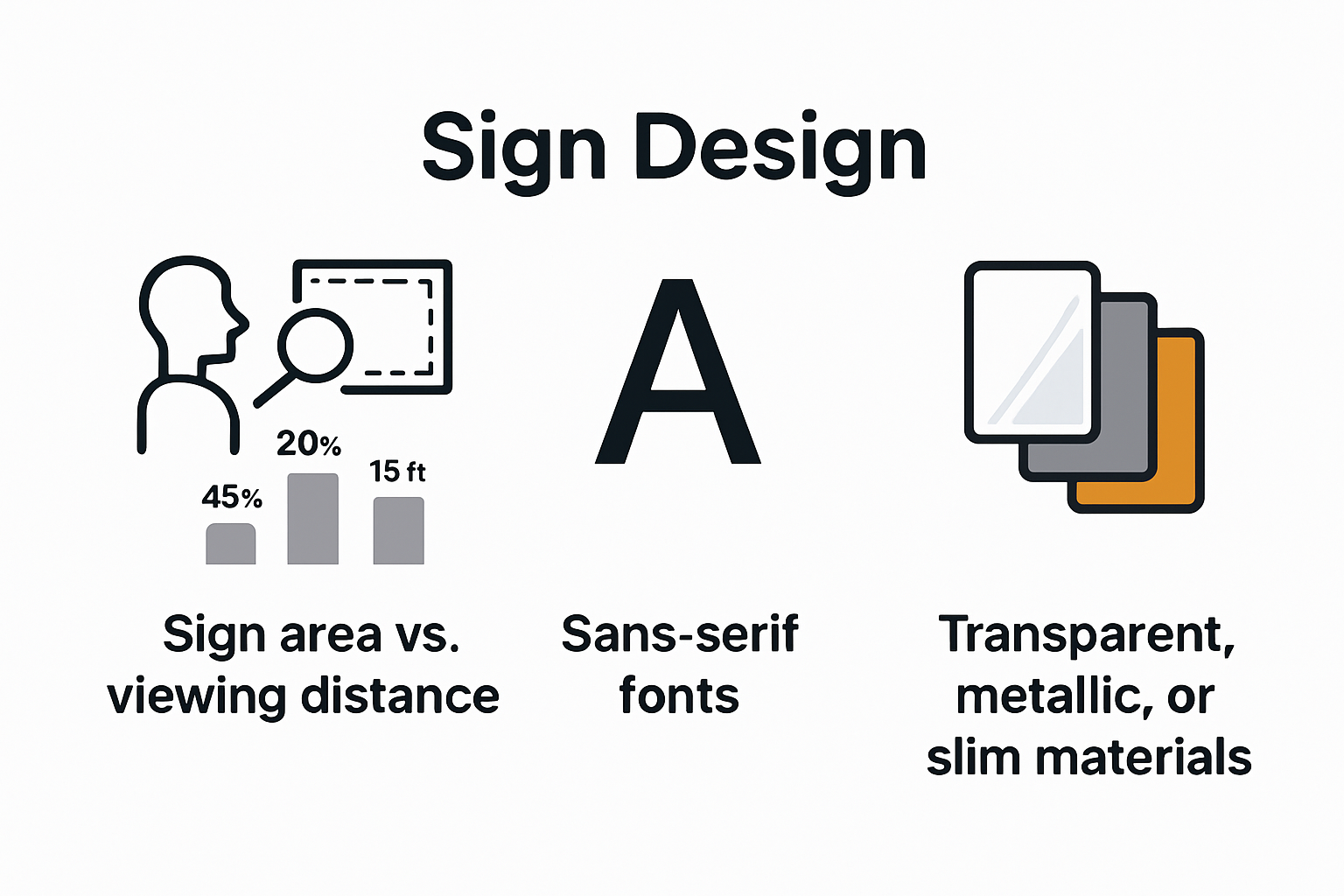
Modern signage solutions leverage technology to overcome spatial limitations. Digital displays with adjustable brightness and content can provide dynamic information without permanent physical installation. Modular sign systems allow for flexible reconfiguration, enabling businesses to adapt their visual communication as spatial needs evolve.
The National Park Service’s UniGuide Standards emphasize selecting typefaces that maintain legibility across different viewing distances. In small spaces, this means choosing fonts that remain clear whether viewed up close or from a slight distance.
By embracing these principles, businesses can transform spatial constraints into opportunities for creative, efficient signage that communicates effectively without overwhelming the environment.
Here is a table summarising key principles for designing signage in small spaces, based on the information provided in this section:
| Principle | Recommended Approach/Example | Benefit |
|---|---|---|
| Typography | Use sans-serif fonts (e.g., Helvetica, Futura) | Enhances readability |
| Contrast | High luminance contrast, light background/dark text (or vice versa) | Ensures clarity and visibility |
| Material Selection | Reflective, metallic, transparent, or slim profile materials | Creates depth/reduces obstruction |
| Strategic Placement | Position at eye level, consider tactile/visual indicators | Guides users without clutter |
| Technological Integration | Digital/modular signage, adjustable brightness | Adaptable, saves space |
Creative Signage Ideas for Maximum Impact
In the realm of small space signage, creativity becomes the ultimate differentiator. Businesses must transform limited visual real estate into powerful communication tools that capture attention and convey essential information efficiently.
Innovative Design Techniques
Our comprehensive guide to retail signage reveals the transformative potential of strategic design. According to a 2024 study published in Buildings, effective signage should occupy approximately 7% of the reading distance to maximize wayfinding capabilities, making precise sizing crucial in compact environments.
Multi-functional signage represents a groundbreaking approach for small spaces. By integrating design elements that serve dual purposes, businesses can maximise impact without overwhelming limited areas. Consider signs that incorporate shelving, mirrors, or interactive digital components, creating visual interest while maintaining practical utility.
Technology and Interaction
The 2017 research paper on FluxMarker demonstrates emerging technologies that enhance information representation. Dynamic tactile markers offer scalable solutions for conveying complex information, particularly beneficial for individuals with visual impairments. Digital displays with adjustable brightness and modular configurations allow businesses to adapt messaging without permanent installations.
Interactive signage transforms passive communication into engaging experiences. QR codes, augmented reality interfaces, and touch-sensitive displays can provide additional layers of information without consuming physical space. These technologies enable businesses to offer comprehensive details while maintaining a minimalist aesthetic.
Sensory and Contextual Design
Research from Pennsylvania Libraries highlights how thoughtful signage design can significantly influence user behavior. By considering color psychology, texture, and contextual placement, businesses can create signs that not only inform but also guide and inspire.
Material selection plays a critical role in small space signage. Reflective surfaces, translucent elements, and slim-profile designs can create visual depth and perceived spaciousness. Lightweight materials like acrylic, brushed metal, and innovative composites offer durability without bulk.
Ultimately, successful signage in small spaces requires a holistic approach that balances aesthetic appeal, functional clarity, and technological innovation. By embracing creative design principles and emerging technologies, businesses can transform spatial constraints into opportunities for memorable visual communication.
Here is a table highlighting innovative signage techniques and their advantages for small spaces:
| Technique/Idea | Description/Approach | Advantage in Small Spaces |
|---|---|---|
| Multi-functional Signage | Combines signage with shelves, mirrors, interactivity | Saves space, adds utility |
| Dynamic Tactile Markers | Touch-activated changing info (e.g., FluxMarker) | Aids accessibility, conveys more info |
| Digital Displays | Adjustable brightness, modular content | Flexible messaging, reduces clutter |
| Interactive Elements | QR codes, AR, touch screens | Provides detail without physical space use |
| Sensory Layering | Uses colour, texture, context in design | Enhances engagement, guides behaviour |
Practical Installation Tips in Compact Spaces
Installing signage in compact spaces requires meticulous planning and precision. Every millimetre counts when working with limited square footage, making strategic placement and mounting techniques critical to successful visual communication.
Strategic Positioning and Mounting
According to the University of Florida’s Institute of Food and Agricultural Sciences, signage placement is paramount in restricted environments. The recommended approach involves positioning signs at eye level in high-traffic areas, ensuring maximum visibility without creating physical obstructions.
Our expert installation guide highlights several key considerations for compact space signage. Lightweight materials like aluminium composite panels and acrylic offer minimal depth while providing durability. Mounting methods such as flush wall mounting or recessed installations can significantly reduce physical intrusion into limited spaces.
The South Australian Department for Education recommends using clear, legible text in at least 18-point font, ensuring readability even in constrained visual environments. This approach helps maintain information clarity while minimising the physical footprint of the signage.
Non-Invasive Mounting Techniques
Harvard University’s Center for Government and International Studies provides critical insights into minimally invasive installation methods. Their signage specifications emphasize using removable mounting solutions like high-strength adhesive strips or 3M Velcro tabs. These techniques prevent surface damage and offer flexibility for future repositioning or updates.
Modular mounting systems represent an innovative solution for compact spaces. Telescopic brackets, rail systems, and magnetic mounting plates allow for precise positioning and easy reconfiguration. These adaptable solutions enable businesses to adjust signage without permanent structural modifications.
Technical Considerations and Safety
Installation in small spaces demands careful attention to weight distribution and structural integrity. Professional installers recommend using multiple mounting points for signs over 2 kilograms, spreading the load to prevent stress on any single attachment point. Precision drilling, level alignment, and using appropriate wall anchors become crucial in maintaining both aesthetic appeal and safety.
Electrical considerations also play a significant role. For illuminated or digital signs, cable management becomes critical. Slim conduit systems, wireless power transmission, and integrated cable channels can maintain a clean, uncluttered appearance while ensuring functional reliability.
Ultimately, successful signage installation in compact spaces is an art form that balances technical precision, aesthetic sensitivity, and practical functionality. By embracing innovative mounting techniques and strategic positioning, businesses can transform spatial limitations into opportunities for impactful visual communication.
Compliance and Branding for London Businesses
For London businesses, navigating the intricate landscape of signage compliance while maintaining a distinctive brand identity presents a nuanced challenge. The interplay between regulatory requirements and creative expression demands strategic approach and meticulous planning.
Regulatory Landscape and Signage Guidelines
Our comprehensive compliance guide provides essential insights into local signage regulations. The City of London Corporation emphasizes responsible business practices, which extend to visual communication and branding strategies.
Businesses must navigate multiple regulatory frameworks, including planning permissions, conservation area restrictions, and environmental considerations. In central London, where architectural heritage and modern commercial needs intersect, signage becomes a delicate balance between individual brand expression and urban aesthetic preservation.
The Greater London Authority’s Business Friendly Licensing initiative aims to streamline compliance processes, recognizing the complexities small businesses face when interpreting complex regulatory requirements.
Brand Identity in Constrained Environments
Effective branding in compact spaces requires innovative thinking. Signage must communicate a business’s core identity while adhering to spatial and regulatory constraints. Colour schemes, typography, and minimal design elements become critical in translating brand essence within limited visual real estate.
The Greater London Authority’s environmental guidance suggests integrating sustainability into branding strategies. This might involve using eco-friendly materials, incorporating energy-efficient lighting, or demonstrating environmental consciousness through signage design.
Strategic Compliance and Brand Communication

Successful businesses view compliance not as a constraint but as an opportunity for creative differentiation. By understanding local regulations and leveraging innovative design principles, companies can develop signage that is both legally compliant and strategically compelling.
Key considerations include maintaining appropriate sign dimensions, respecting historical architectural contexts, ensuring visibility without visual pollution, and aligning with local community aesthetics. Businesses must also consider accessibility requirements, ensuring signage is legible and comprehensible for diverse audiences.
Ultimately, compliance and branding in London’s dynamic business environment require a holistic approach. By viewing regulatory guidelines as a framework for creativity rather than a limitation, businesses can develop signage solutions that are legally sound, visually striking, and true to their brand identity.
Frequently Asked Questions
What type of typography is best for small space signage?
Sans-serif fonts, such as Helvetica and Futura, are recommended for small space signage because they enhance readability and maintain a clean aesthetic without overwhelming limited visual areas.
How can I effectively integrate technology into small space signage?
Utilising digital displays and modular signage allows for flexible updates and adaptable information presentation, making them an effective way to communicate messages in compact environments without permanent installations.
What are the key considerations for mounting signage in compact areas?
Signage should be positioned at eye level in high-traffic areas to maximise visibility. Non-invasive mounting techniques like high-strength adhesive strips or modular mounting systems are advisable to reduce physical intrusion in limited spaces.
How can I ensure compliance with local signage regulations?
To ensure compliance, businesses should understand local guidelines regarding dimensions, placement, and design. Engaging with relevant regulatory frameworks and considering community aesthetics helps create signage that is both compliant and visually appealing.
Unlock Clarity and Impact in Tight Spaces with Promosigns
Struggling to make your shop signs stand out in restricted locations? Many businesses face the frustration of maintaining clear, readable, and high-impact signage when every centimetre matters. The article highlights how choices in typography, placement, and modern technology shape effective communication in compact environments. At Promosigns, our team understands how vital it is to balance compliance, brand identity, and innovative design without creating visual clutter. We help UK businesses turn these challenges into engaging signage solutions.

Let your space work smarter for your brand. Visit Promosigns to discover how our custom shop signs, illuminated options, and large format printing expertly address small-space needs. Whether you want dynamic digital displays or sleek, minimal shopfronts, our designers are ready to help. Take the next step now and create signage perfectly crafted for your unique location by booking a free consultation through our site.
Recommended
- Signage for Interior Designers: Trends and Solutions 2025 – PromoSigns.co.uk
- Office Signage Ideas for London Businesses and Events: 2025 Trends – PromoSigns.co.uk
- Signage for Office Interiors: 2025 Guide for London Businesses – PromoSigns.co.uk
- Effective Signage for Architects: 2025 Guide for London Businesses – PromoSigns.co.uk
