
Choosing the right business sign in London might sound simple and yet an incredible 88 percent of consumers say signage is the main reason they entered a shop. Most owners splash out on flashy designs or the biggest logo they can afford, thinking size or colour are everything. The real clincher often hides in the small print like local rules or clever placement that actually determines who walks through your door.
Table of Contents
Table of Contents
- Understanding Types Of Signage For Businesses
- Key Factors When Choosing Signage
- Design And Placement For Maximum Impact
- Legal Requirements And London Regulations
Quick Summary
| Takeaway | Explanation |
|---|---|
| Choose the right sign type | Select from various types like wall, projecting, or window signs based on your goals and location. |
| Prioritise visibility and design | Ensure signs are large and well-placed for maximum visibility and readability at a distance. |
| Understand legal requirements | Familiarise yourself with local regulations and planning permissions to avoid penalties. |
| Strategic placement is crucial | Position signs at key decision points to enhance visibility and guide customers effectively. |
| Integrate design with function | Combine aesthetic elements with technical considerations to create engaging and effective signage. |
Understanding Types of Signage for Businesses
Choosing the right signage is critical for businesses seeking to communicate their brand message and attract potential customers. The world of business signage is diverse and complex, offering multiple options to suit different commercial needs and aesthetic preferences.
Exterior Signage: Making a First Impression
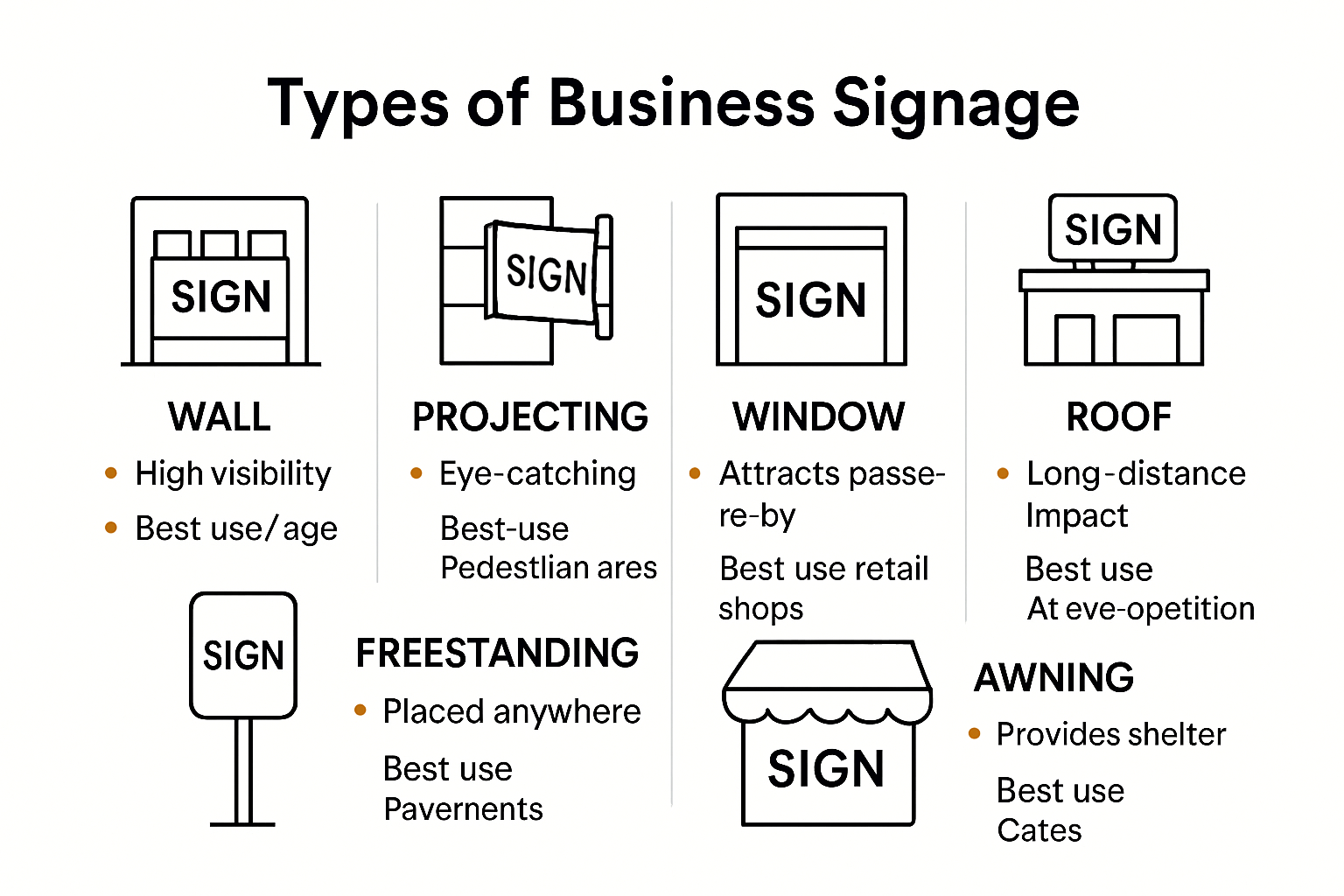
Exterior signage serves as the visual ambassador for your business, creating the initial point of contact with potential customers. Research from the National Park Service highlights six primary types of exterior signage that businesses can leverage:
- Wall Signs: Mounted directly on building facades, providing straightforward brand visibility
- Projecting Signs: Extending perpendicular to the building, capturing attention from multiple angles
- Window Signs: Utilising glass surfaces to communicate promotions or brand messaging
- Roof Signs: Elevated displays visible from a distance
- Freestanding Signs: Independent structures that can be placed strategically around a property
- Awning Signs: Combining functional shade with brand communication
Each sign type offers unique advantages in terms of visibility, brand representation, and customer engagement. The selection depends on your specific business location, architectural constraints, and marketing objectives.
Interior Signage: Enhancing Customer Experience
While exterior signage attracts attention, interior signage plays a crucial role in guiding customer navigation and reinforcing brand identity. Our comprehensive guide on commercial signage explores how businesses can use interior signage effectively.
Interior signage types include:
- Directional Signs: Helping customers navigate complex spaces
- Informational Signs: Providing essential details about services, products, or policies
- Branded Environment Signs: Creating immersive brand experiences within your space
Successful signage goes beyond mere visual communication. It represents a strategic tool for brand storytelling, customer interaction, and creating memorable business experiences. Understanding the nuanced role of different signage types enables businesses to make informed decisions that align with their marketing goals and brand identity.
By carefully selecting and implementing appropriate signage, businesses can transform their visual communication from a passive element to an active marketing strategy that drives customer engagement and brand recognition.
Below is a table summarising the main types of exterior and interior signage discussed, along with their key features and uses:
| Signage Type | Placement | Main Purpose | Key Features |
|---|---|---|---|
| Wall Signs | Exterior | Brand visibility | Directly mounted, visible to passers-by |
| Projecting Signs | Exterior | Capture attention from angles | Extends perpendicular to façade |
| Window Signs | Exterior | Promotions/branding | On glass, easily changeable |
| Roof Signs | Exterior | Long-distance visibility | Elevated, visible from afar |
| Freestanding Signs | Exterior | Guide/attract from multiple points | Standalone, flexible placement |
| Awning Signs | Exterior | Shade and branding | Integrated into canopy |
| Directional Signs | Interior | Customer navigation | Guides flow, clarifies complex layouts |
| Informational Signs | Interior | Inform customers | Service/policy/product information |
| Branded Env. Signs | Interior | Immersive brand experience | Decorative, reinforces identity |
Key Factors When Choosing Signage
Selecting the right signage is a strategic decision that can significantly impact a business’s visibility, brand perception, and customer engagement. Beyond mere aesthetic considerations, multiple critical factors must be carefully evaluated to ensure your signage effectively communicates your brand message.
Visibility and Design Considerations
According to the U.S. Chamber of Commerce, designing signage requires a comprehensive approach that reflects a company’s brand identity while meeting practical communication objectives. The International Sign Association provides fascinating insights into sign effectiveness, noting that at high speeds, viewers have mere seconds to absorb visual information.
Research from the International Sign Association highlights five critical elements for sign effectiveness:
- Size: Ensuring the sign is proportionate to its viewing distance
- Angle: Positioning the sign for maximum visibility
- Location: Strategic placement to capture viewer attention
- Luminance: Appropriate brightness for different lighting conditions
- Contrast: Creating clear, readable visual communication
Businesses must consider these technical aspects alongside creative design principles. Our comprehensive guide on commercial signage offers deeper insights into navigating these complex considerations.
Legal and Practical Constraints
Beyond design aesthetics, businesses must navigate a complex landscape of regulatory requirements. Local zoning laws, building regulations, and permit specifications can significantly impact signage choices. The U.S. Chamber of Commerce emphasizes the importance of understanding and complying with these legal frameworks before finalizing any signage design.
Practical considerations extend beyond legal compliance. Material selection plays a crucial role in durability, maintenance costs, and long-term performance. Businesses must evaluate factors such as:
- Weather resistance
- Maintenance requirements
- Material longevity
- Installation complexity
- Budget constraints
Each material and design choice represents a balance between aesthetic appeal, functional performance, and financial investment. Signage is not merely a decorative element but a strategic communication tool that represents your brand’s professionalism and attention to detail.
By meticulously evaluating these multifaceted considerations, businesses can develop signage that not only captures attention but also effectively communicates their brand’s unique value proposition. The right signage transforms from a passive background element to an active marketing instrument that engages potential customers and reinforces brand identity.
To help clarify the main technical and design factors for effective signage, see the table below:
| Factor | Why It Matters | How to Optimise |
|---|---|---|
| Size | Must be visible from intended distance | Match sign size to viewing range |
| Angle | Affects how easily it’s seen | Position perpendicular to traffic |
| Location | Impacts who sees/signs engagement | Place at high-traffic areas |
| Luminance | Day/night and weather readability | Adjust brightness as needed |
| Contrast | Ensures clarity and readability | Use high contrast colours |
| Material Choice | Determines longevity & maintenance | Choose weather-proof materials |
| Installation | Affects stability and safety | Hire professionals when required |
Design and Placement for Maximum Impact
Effective signage transcends mere visual aesthetics, requiring strategic design and precise placement to maximize communication and engagement. Understanding how design elements interact with spatial environments can transform a simple sign into a powerful marketing tool.
Strategic Positioning and Visibility
Research on tourism signage systems highlights the critical importance of positioning signs at key decision points. These strategic locations ensure maximum visibility and guide viewer attention effectively. Businesses must consider multiple factors when determining sign placement:
- Sight Lines: Position signs where they can be easily viewed without obstruction
- Traffic Flow: Align signage with natural human movement patterns
- Environmental Context: Consider surrounding architectural and landscape elements
Interestingly, studies on environmental signage suggest that signs placed in less cluttered environments receive more favorable attention. This principle underscores the importance of creating visual breathing space around your signage.

Design Elements for Maximum Impact
Design is not just about looking attractive but communicating effectively. Our guide on window graphics explores how visual elements can capture attention and convey brand messaging.
Key design considerations include:
- Color Psychology: Selecting colors that evoke desired emotional responses
- Typography: Choosing fonts that enhance readability and reflect brand personality
- Negative Space: Utilizing white space to create visual hierarchy and clarity
- Scalability: Ensuring design remains legible at different sizes and distances
Technical Considerations for Sign Effectiveness
Beyond aesthetic elements, technical factors significantly influence sign performance. Material selection, lighting conditions, and viewing angles play crucial roles in communication effectiveness.
Businesses must evaluate:
- Material Durability: Selecting materials that withstand environmental conditions
- Lighting Integration: Incorporating appropriate illumination for day and night visibility
- Viewing Distance: Designing signs that remain clear at expected viewer distances
Successful signage represents a sophisticated blend of artistic design, technical precision, and strategic communication. By thoughtfully integrating visual elements with spatial understanding, businesses can create signs that do more than inform – they engage, inspire, and connect with their target audience.
The most impactful signs are those that seamlessly merge form and function, transforming from mere informational tools into dynamic brand ambassadors that communicate complex messages in a single, compelling visual moment.
Legal Requirements and London Regulations
Navigating the complex landscape of signage regulations is crucial for businesses seeking to display their signs legally and professionally. London’s regulatory environment presents unique challenges and requirements that demand careful consideration and strategic planning.
Planning Permission and Advertisement Consent
The UK government’s official guidance provides comprehensive insights into the intricate system of advertisement control in England. Businesses must understand that not all signs can be displayed without formal approval.
According to the Planning Portal, planning permission or advertisement consent is typically required when:
- Size Exceeds Standard Limitations: Signs that are larger than prescribed dimensions
- Location in Sensitive Areas: Signage near listed buildings or conservation zones
- Illuminated Signs: Certain types of illuminated or digital signage
- Frequency of Changes: Signs with frequently changing content
Local Authority Considerations
The government’s detailed regulations outline specific factors local planning authorities evaluate when assessing sign applications. Our comprehensive retail signage compliance guide provides additional context for businesses navigating these complex requirements.
Key considerations include:
- Visual Impact: How the sign affects the surrounding streetscape
- Heritage Preservation: Potential impact on historical architectural environments
- Public Safety: Ensuring signs do not obstruct traffic or pedestrian movement
- Environmental Aesthetics: Maintaining the visual character of the local area
Specific London Regulatory Nuances
London’s unique architectural and historical context creates additional layers of complexity for signage regulations. Businesses must be particularly attentive to:
- Conservation area restrictions
- Listed building signage guidelines
- Specific borough-level regulations
- Temporary versus permanent signage rules
Compliance is not merely about avoiding legal penalties but demonstrating respect for the city’s rich architectural heritage and urban design principles. Each sign represents an opportunity to contribute positively to London’s visual landscape while effectively communicating your brand message.
Businesses that invest time in understanding these regulations can transform potential regulatory challenges into strategic opportunities for creative and compliant signage design. The most successful approaches blend legal adherence with innovative visual communication, ensuring that your signage not only meets regulatory standards but also captivates and engages your target audience.
Frequently Asked Questions
What types of signage are best for businesses in London?
Choosing the right type of signage depends on your specific needs. Effective options include wall signs for direct visibility, projecting signs to capture attention from various angles, window signs for changing promotions, and freestanding signs for strategic placement.
How important is the design and visibility of my signage?
The design and visibility of your signage are critical as they influence whether potential customers notice and enter your business. Ensure that your signs are well-designed, easily readable from a distance, and strategically positioned in high-traffic areas.
Are there specific legal requirements for signage in London?
Yes, businesses in London must comply with various legal requirements, including obtaining planning permission or advertisement consent for certain types of signage, particularly if they are larger than specified dimensions or located in sensitive areas.
How can I enhance the effectiveness of my signage?
To enhance the effectiveness of your signage, consider key factors such as optimal size and contrast for visibility, strategic placement at decision points, and incorporating design elements like colour psychology and typography that align with your brand identity.
Ready to Remove Uncertainty from Your Business Signage Choices?
Modern business owners in London face unique challenges when it comes to getting signage right. Maybe you are struggling with local regulations, or you worry that your sign simply does not stand out in the sea of competition. This article showed that visibility, compliance and smart design all drive customer attention and create real walk-ins. You want your investment to pay off, but legal pitfalls and confusing size rules can be discouraging.

Do not let obstacles hold your business back. Our specialist team at PromoSigns brings together decades of experience in designing and installing custom shop signs across London, Essex and Kent. We will guide you through the whole process, making sure your signage is both eye-catching and fully compliant. Visit our website now to request a free consultation and get your project moving today.
Recommended
- Graphic Design Tips for Signage: 2025 Guide for London Businesses – PromoSigns.co.uk
- Types of Shop Signs for London Businesses: The 2025 Guide – PromoSigns.co.uk
- Signage and Brand Recognition: Boost Your London Business in 2025 – PromoSigns.co.uk
- Signage Design Principles for London Businesses in 2025 – PromoSigns.co.uk
