
Designing banners might seem straightforward, yet getting real attention is incredibly rare. Banners that truly connect share three characteristics: instant comprehension, emotional pull, and perfect context fit. People assume a splash of colour and a catchy phrase is enough. The real breakthrough comes when you treat purpose and audience targeting as your secret weapon. That is where everything changes.
Table of Contents
- Step 1: Define Your Banner’s Purpose And Audience
- Step 2: Choose The Right Dimensions And Format
- Step 3: Select Compelling Visuals And Branding Elements
- Step 4: Craft Attention-Grabbing Messaging
- Step 5: Review And Refine Your Design
- Step 6: Test Your Banner’s Effectiveness Before Launch
Table of Contents
Quick Summary
| Key Point | Explanation |
|---|---|
| 1. Define your banner’s purpose clearly | Identify your banner’s specific message to ensure it meets your communication goals effectively. |
| 2. Select appropriate dimensions and format | Choose sizes and formats that suit the banner’s environment for optimal visibility and impact. |
| 3. Choose visuals that resonate with the audience | Utilize color, typography, and brand elements to create a compelling visual narrative. |
| 4. Craft concise and engaging messaging | Distill your message to its essentials for quick, impactful communication of your value proposition. |
| 5. Test effectiveness with target audience | Gather feedback on your banner’s design and messaging to ensure clarity and emotional resonance before launch. |
Step 1: Define Your Banner’s Purpose and Audience
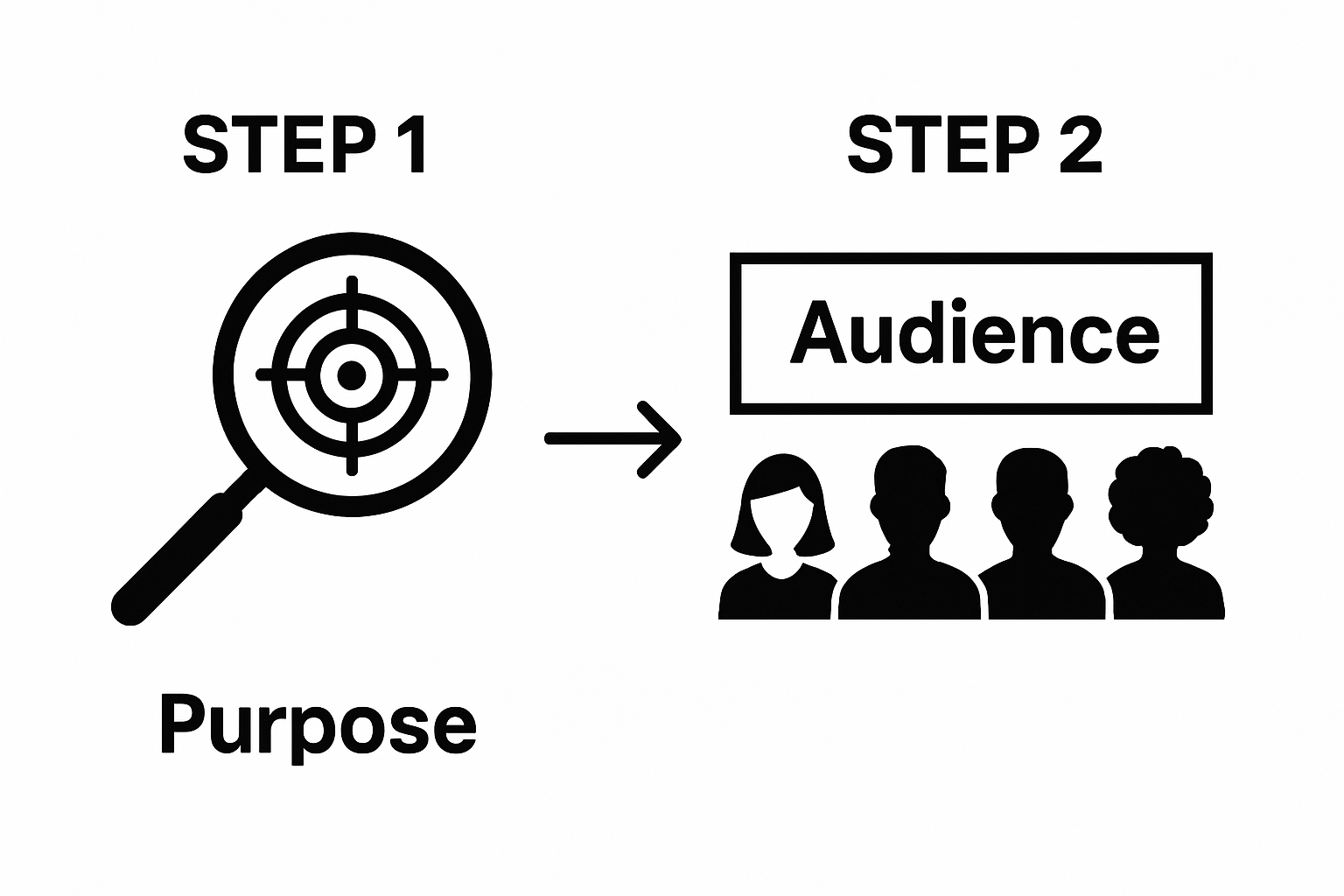
Designing impactful banners begins with a crystal clear understanding of your communication objectives and target audience. This foundational step determines the entire trajectory of your visual communication strategy, transforming a generic design into a powerful business tool.
Starting with purpose means identifying the precise message and goal your banner needs to accomplish. Are you promoting a new product launch, announcing a seasonal sale, providing directional information, or creating brand awareness? Each objective demands a unique visual approach. A banner designed to attract retail customers will look dramatically different from one intended for corporate event signage.
Audience analysis forms the critical companion to purpose. Your banner’s visual language, colour palette, typography, and imagery must resonate directly with your intended viewers. A banner targeting young professionals will employ a distinctly different aesthetic compared to one aimed at senior executives or families. Consider demographic factors like age range, professional background, cultural context, and visual preferences. Precise audience targeting transforms a simple banner from background noise into a compelling communication instrument.
Visual research suggests that banners achieving maximum impact demonstrate three key characteristics: immediate comprehension, emotional resonance, and contextual relevance. Successful designs communicate their core message within seconds, trigger an emotional response, and feel completely natural within their intended environment.
To verify you have successfully completed this initial design phase, ask yourself these critical questions: Can I describe my banner’s purpose in one clear sentence? Do I understand exactly who will view this banner? Can I predict how my target audience will likely respond to the design?
By investing time in defining purpose and understanding your audience, you lay the groundwork for creating visually striking marketing materials that do not merely communicate but genuinely connect with viewers. When you are ready to move from design to production, working with a specialist in banner printing London ensures your concept is translated into print with the colour accuracy and material quality your brand demands.
Step 2: Choose the Right Dimensions and Format
Selecting the appropriate dimensions and format represents a critical decision in designing impactful banners. The physical or digital space your banner will occupy determines its visual effectiveness, readability, and overall communication potential.
Dimensions are not a one-size-fits-all proposition. Different environments demand specific banner sizes. Indoor retail displays require compact, focused designs, while exterior building signage needs larger, more expansive formats that capture attention from significant distances. Your banner’s intended placement dictates its optimal dimensions. Consider viewing distance, surrounding visual elements, and the typical eye-level of your target audience when determining size.
Format selection involves understanding the nuanced requirements of your display medium. Digital platforms demand pixel-perfect resolution and compatible file types like PNG or vector graphics. Physical print banners require high-resolution images, considering factors such as material texture, potential viewing angles, and potential environmental exposure. Professional printing services often recommend specific file formats and resolution standards to ensure maximum visual clarity.
Practical considerations extend beyond pure aesthetics. Budget constraints, material availability, and installation logistics play significant roles in dimension and format decisions. A banner for a temporary trade show exhibit differs dramatically from a permanent storefront installation.
| Environment | Recommended Dimensions | Format Considerations | Key Design Focus |
|---|---|---|---|
| Indoor Retail Display | Compact (e.g. 0.6m x 1.5m) | Easy installation, lightweight material | Sharp visuals, audience proximity |
| Exterior Building Sign | Large (e.g. 3m x 1m or bigger) | Weather-resistant, high-impact print | Readability from distance |
| Trade Show Exhibit | Varies (often modular) | Portable, flexible materials | Brand clarity, fast setup |
| Digital Platform | Pixel-specific (e.g. 1200x600px) | High resolution, web-safe formats | Crisp images, clear CTAs |
| Permanent Storefront | Custom to space | Durable material, fade-resistant print | Long-term brand appeal |
To verify your dimension and format choices, conduct a simple visual test. Print a scaled mockup or create a digital prototype. Ask yourself: Does the banner maintain clarity at intended viewing distances? Does the chosen format preserve design integrity across different display contexts? Can the design be easily reproduced without losing visual impact?
For more comprehensive insights into selecting the ideal printing format for your business needs, explore professional printing resources that can guide your technical decision-making process. For large outdoor installations or building-scale displays, large format printing London specialists can advise on the precise dimensions, materials, and resolution specifications needed for maximum impact.
Step 3: Select Compelling Visuals and Branding Elements
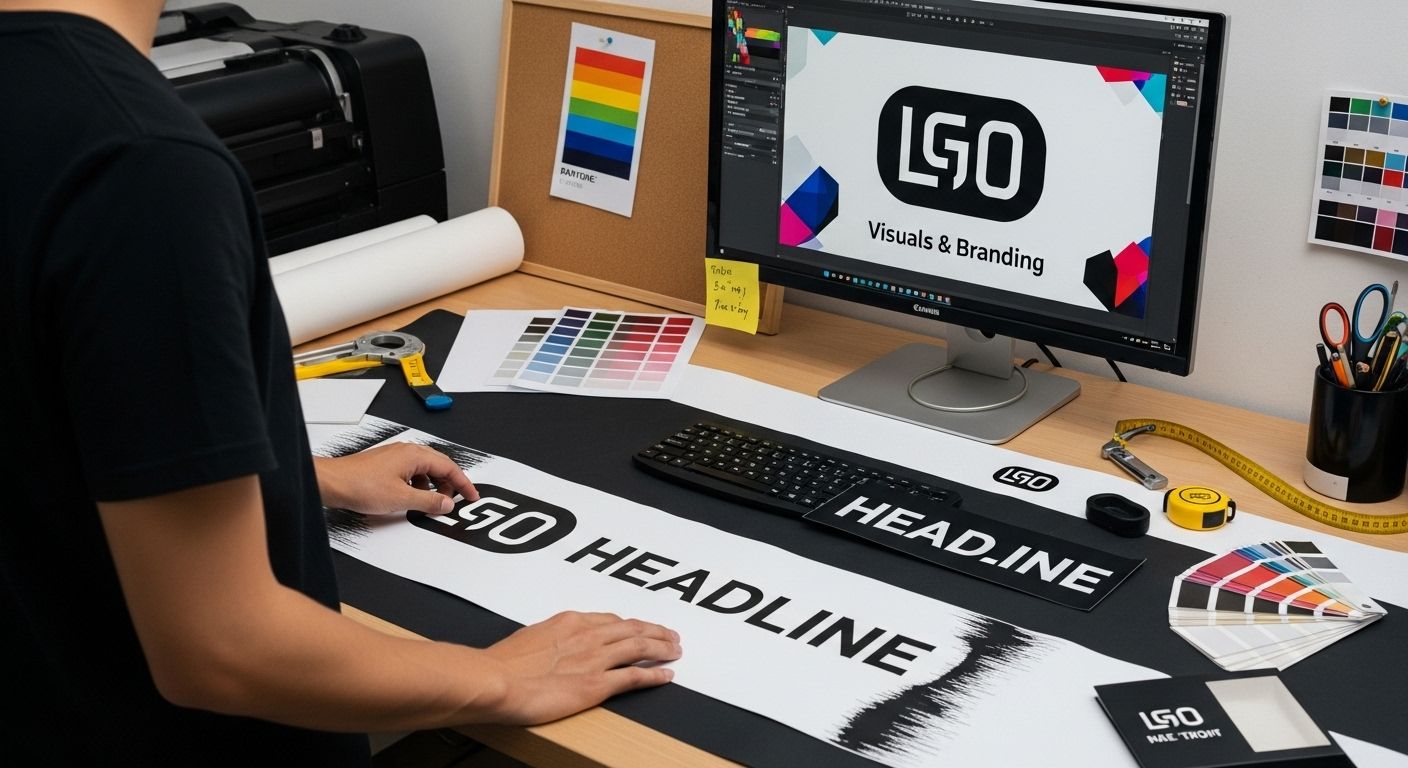
Selecting compelling visuals and branding elements transforms your banner from a mere information carrier to a powerful communication instrument. This crucial step determines how effectively your visual message connects with your target audience, communicating your brand’s essence in a single glance.
Colour psychology plays a pivotal role in visual communication. Each colour palette evokes specific emotional responses and carries distinct psychological implications. Blues communicate professionalism and trust, while warm oranges suggest energy and creativity. Your chosen colours must align seamlessly with your brand identity and resonate with your target demographic. Professional designers recommend selecting a primary brand colour and complementary secondary colours that create visual harmony while maintaining clear readability.
Visual hierarchy becomes critical in designing impactful banners. The human eye naturally follows specific visual pathways, and understanding this principle allows you to strategically place key information. Your most important message should occupy the most prominent visual space, with secondary details positioned to guide the viewer’s attention progressively. Typography also serves as a powerful visual element — font selection communicates personality. Bold, sans-serif fonts suggest modernity and confidence, while elegant serif typefaces imply tradition and sophistication.
Brand consistency represents the cornerstone of effective visual communication. Every visual element must reflect your organisation’s core identity. This means incorporating your logo, maintaining consistent font styles, and ensuring colour schemes align with existing brand guidelines. Subtle design elements like graphic motifs, iconography, and visual textures can subtly reinforce brand recognition.
To verify your visual selections, conduct a simple test. Step back from your design and ask: Does this banner tell a clear story at first glance? Would a stranger immediately understand the core message? Can they identify the brand without reading text?
For deeper insights into creating powerful visual branding strategies, explore professional design resources that can elevate your visual communication approach. For outdoor banners that need to hold colour in all weathers, mesh banner printing London offers a wind-resistant, fade-resistant solution that maintains visual vibrancy even on exposed building facades.
Step 4: Craft Attention-Grabbing Messaging
Crafting attention-grabbing messaging transforms your banner from a generic visual display into a powerful communication tool. The right message acts like a magnetic force, drawing viewers into your narrative and compelling them to engage with your brand’s core proposition.
Concision represents the cornerstone of effective banner messaging. You have mere seconds to communicate your core value proposition, which demands ruthless editing and crystal clear communication. Professional copywriters recommend distilling your message down to its most essential elements. Think of your text as a verbal laser beam — precise, focused, and impossible to ignore. Every word must earn its place on the banner, delivering maximum impact with minimal language.
Emotional resonance elevates messaging from informative to memorable. Your words should not just inform but provoke a specific emotional response. Understand your audience’s core desires, challenges, and aspirations. Are they seeking convenience? Transformation? Solution? Your messaging must directly address these underlying motivations. Powerful messaging creates an instant connection by demonstrating that you understand their needs at a fundamental level.
Language selection goes beyond mere vocabulary. The tone, rhythm, and psychological triggers in your words determine their effectiveness. Active voice, direct statements, and action-oriented language create a sense of immediacy. Phrases that start with verbs — “Discover”, “Transform”, “Unlock” — generate more engagement than passively constructed sentences. Psychological triggers like urgency, exclusivity, and benefit-driven language can dramatically increase your message’s impact.
To verify your messaging’s effectiveness, conduct a simple test. Share your banner draft with individuals unfamiliar with your brand. Can they instantly comprehend the core message? Does the text provoke curiosity or emotional response? Would they be compelled to learn more?
For deeper insights into creating compelling visual communication strategies, explore professional design resources that can refine your messaging approach. Once your messaging is finalised, applying the same clarity and boldness to your wider shopfront — including shop signs London — ensures consistent brand communication from the banner to the building.
Step 5: Review and Refine Your Design
Reviewing and refining your banner design represents the critical final stage that transforms a good concept into an exceptional visual communication tool. This meticulous process ensures your banner meets professional standards and achieves its intended communication objectives.
Objective distance becomes your most valuable design asset. Step away from your initial design and return with fresh eyes, approaching the banner as if you were seeing it for the first time. Professional designers recommend creating physical or digital distance between design iterations. Print a full-scale mockup, place it in a different room, or save the file and return to it after several hours. This perspective shift allows you to identify potential weaknesses, visual inconsistencies, and areas requiring refinement.
Multi-perspective review offers comprehensive insights. Gather feedback from colleagues, potential target audience members, and design professionals. Each perspective reveals nuanced design considerations you might have overlooked. Some individuals will focus on visual aesthetics, while others might highlight practical communication challenges. Constructive criticism is not a personal attack but a valuable design improvement mechanism. Be prepared to hear honest, potentially uncomfortable feedback and view it as an opportunity for enhancement.
Technical precision matters as much as creative vision. Meticulously check technical specifications like resolution, colour accuracy, file compatibility, and scaling potential. Ensure your banner maintains visual clarity across different display contexts — from digital platforms to large-format physical displays. Verify that text remains readable, colours remain true, and design elements retain their intended impact when resized or viewed from varying distances.
To verify your banner’s effectiveness, develop a comprehensive checklist. Ask yourself critical questions: Does the design communicate its core message instantly? Would a stranger understand the banner’s purpose within three seconds? Does the visual hierarchy guide the viewer’s attention effectively? Have you eliminated unnecessary visual clutter?
| Checklist Item | How to Verify | Complete (Yes/No) |
|---|---|---|
| Core message is clear | Can a stranger understand the purpose within three seconds? | |
| Visual hierarchy effective | Does the layout guide the viewer’s attention to key information? | |
| Readability at distance | Is the text legible from intended viewing distances? | |
| Brand consistency | Do colours, fonts, and logos match your brand guidelines? | |
| Technical specifications met | Are resolution, colour accuracy, and file types appropriate for use? | |
| Visual clutter minimised | Have unnecessary elements and distractions been removed? | |
| Multi-perspective feedback gathered | Have colleagues or test viewers reviewed and commented? |
Explore professional design refinement strategies to elevate your banner from good to exceptional, ensuring your visual communication achieves maximum impact.
Step 6: Test Your Banner’s Effectiveness Before Launch
Testing your banner’s effectiveness before launch represents the ultimate validation of your design strategy, transforming theoretical concepts into measurable communication performance. This critical phase determines whether your visual creation will genuinely connect with your target audience or fall into the realm of forgettable marketing materials.
Audience perception testing forms the cornerstone of effective banner evaluation. Conduct controlled experiments where potential viewers are exposed to your banner design for brief intervals. Measure their immediate reactions, comprehension, and emotional responses. Professional marketers recommend tracking metrics like visual attention duration, message recall, and emotional engagement. A successful banner should communicate its core message within three seconds and provoke an immediate, intuitive understanding.
Multi-format testing ensures comprehensive performance validation. Your banner must maintain visual integrity across different platforms and display contexts. Test the design in digital and physical formats, examining how colours, typography, and visual elements translate between screens, print materials, and large-format displays. Consider variations in lighting, viewing distance, and potential environmental distractions. A banner that looks compelling on a computer screen might lose its impact when printed or displayed in a different context.
Quasi-experimental feedback gathering provides nuanced insights. Assemble a diverse test group representing your target demographic. Present the banner in controlled settings and collect structured feedback. Encourage participants to articulate their immediate impressions, emotional responses, and potential areas of confusion. Honest, unfiltered feedback is more valuable than polite compliments. Look for patterns in responses that reveal potential communication barriers or misunderstandings.
To verify your banner’s effectiveness, establish clear pre-defined success criteria. Can viewers instantly comprehend the core message? Does the design provoke curiosity or emotional resonance? Would test participants be compelled to learn more about your offering?
Discover strategies for avoiding common design pitfalls and ensure your banner achieves maximum communicative impact before final launch. Once testing confirms your design is ready, vinyl sticker printing London offers a fast-turnaround option for applying tested graphics to windows, walls, and surfaces as part of your broader campaign rollout.
Turn Expert Banner Design Into Real Business Results
You have learned how crucial purpose, messaging, and brand consistency are for banner success. But without the right production partner, even the best ideas can fall flat. Are you struggling to transform your perfectly crafted concepts into banners that truly stand out across London, Essex, and Kent? The pain points are clear. Many businesses face uncertainty turning design principles into physical signs that capture attention, remain professional, and keep branding intact. You want immediate impact, not just promises on paper.
Make your next move towards business success. Partner with a signmaker who can design, print, and install banners that truly work in the real world. Visit our main site today to see how our large format printing and visual branding solutions will turn your ideas into compelling signs. Take the next step now so your banners connect, inspire, and drive results — every time.
Frequently Asked Questions
What are the key elements to consider when defining the purpose of a banner?
When defining the purpose of a banner, it’s essential to identify the specific message you want to communicate and the goals you wish to achieve, such as promoting a product, announcing a sale, or providing directional information.
How can I effectively choose the right dimensions and format for my banner?
Choosing the right dimensions and format involves considering the location where the banner will be displayed, viewing distance, and the digital or physical medium you will use. Larger, outdoor banners require different dimensions than smaller, indoor displays.
What factors should I consider when selecting visuals and branding elements for my banner?
When selecting visuals, consider colour psychology, visual hierarchy, and brand consistency. Ensure that your colours and images resonate with your target audience and align with your brand identity to create an impactful design.
How can I test my banner’s effectiveness before its launch?
To test your banner’s effectiveness, conduct audience perception tests where potential viewers are exposed to the design briefly and assess their immediate reactions and understanding. Gathering feedback from a diverse test group can provide valuable insights into the banner’s performance.
Recommended
- Tips for Designing Eye-Catching Roll-Up Banners
- Banner Printing Southgate
- 5 Common Mistakes in Custom Banner Printing for Brand
- 5 Common Mistakes in Custom Banner Printing for Brand
